April 26, 2025
Engineering Decision in Air Handling Units: EC Fan or AC Plug Fan?
Selecting the right fan technology for your HVAC projects directly affects both capital expenditure (CAPEX) and operating expenses (OPEX). Here is a technical comparison and application guide for EC Fans versus AC Plug Fans with Frequency Inverters.

Engineering Decision in Air Handling Units: EC Fan or AC Plug Fan?
In modern air conditioning systems (HVAC), the "Belt-Driven" era has officially closed. Now the two real rivals on the table are; EC (Electronically Commutated) Fans and AC Plug Fans with Frequency Inverters.
The most common mistake investors and mechanical designers make is comparing these two technologies based solely on "Price". However, in engineering, the right question is: "Which technology is best suited to the characteristics of my process (Variable Flow vs. Constant Flow)?"
As Axvorn Engineering, we analyze the technical DNA of both technologies in this article and explain which one is the "winner" in which scenario.
1. Putting the Technology on the Table
EC Fan (Electronically Commutated): Motor of the Digital Age
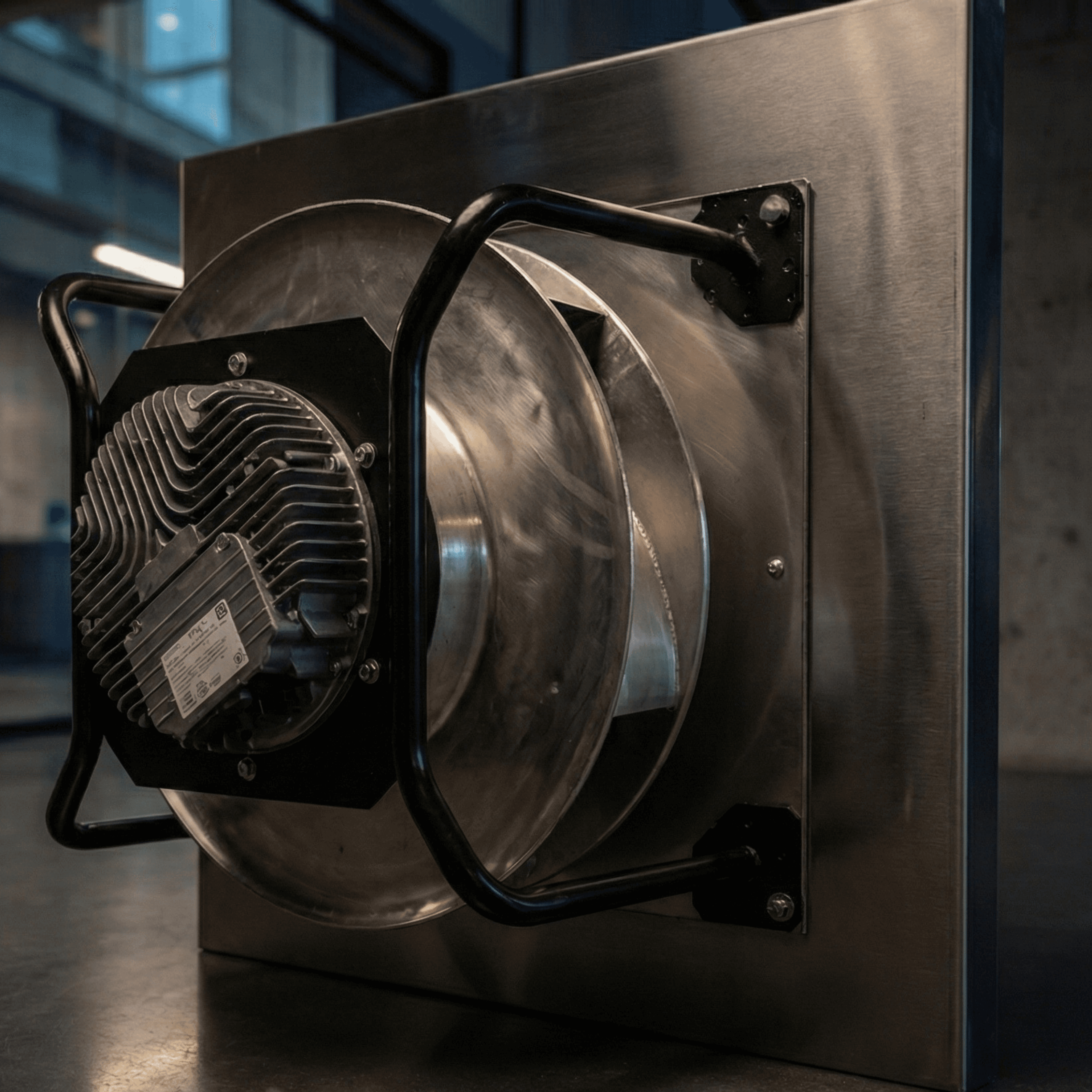
EC technology combines the efficiency of a brushless DC motor with integrated driver electronics.
Efficiency Class: Usually in the IE5 (Ultra Premium Efficiency) standard.
Structure: Motor and driver (inverter) are integrated in a single body. It does not require external panel components.
Characteristics: It does not experience efficiency loss, especially in partial loads. When the fan speed drops to 50%, energy consumption decreases dramatically.
AC Plug Fan (Direct Drive): Powerful and Familiar
This is a system where a classic AC asynchronous motor is directly connected to the fan impeller without belts and pulleys. It requires an external Frequency Inverter (VFD) for speed control.
Efficiency Class: Generally IE3 or IE4 class motors are used.
Structure: The motor and fan impeller are coupled, but the speed controller sits separately in the panel.
Characteristics: At full load (100% capacity), its efficiency is close to EC, but as speed decreases, the motor's efficiency curve may not remain as stable as EC.
2. Which One Should Be Chosen for Which Project?
Here is the "Right Product in the Right Place" strategy formed by Axvorn Engineering's field experience:
SCENARIO A: Areas Where EC Fans are Unrivaled
Variable Air Volume (VAV) Systems: Places where human density constantly changes throughout the day, such as shopping malls, hotels, offices, and hospitals. If the system operates at 40-60% capacity most of the time, EC fans provide up to 20% extra savings compared to their AC competitors.
Restricted Areas (Renovation): EC fans are more compact (thanks to the "External Rotor" structure). When driving a retrofit of an existing narrow air handling unit, it delivers increased capacity without extending the unit length.
Fan Wall Applications: Using multiple small fans instead of a single large fan (Array). The "Plug-and-Play" and mutual communication capability of EC fans significantly reduces automation costs in these systems.
Hygiene Critical Areas: EC fans emit less heat and do not produce belt dust. It is ideal for cleanrooms.
SCENARIO B: Areas Where AC Plug Fans (with VFD) are Preferred
Constant Air Volume (CAV) Processes: If an industrial exhaust fan or production line ventilation runs at 100% full capacity 24/7, the efficiency gap between EC and AC may not be wide enough to justify the ROI period. Here, an AC Plug Fan offering lower initial investment cost (CAPEX) can be a logical engineering choice.
Challenging Power Grids: Electronic boards on EC fans are sensitive to voltage fluctuations (harmonics). In heavy industrial facilities where the power infrastructure is highly unstable, AC motors with external drives and robust bodies can sometimes be a more robust choice.
High Temperatures: Some EC models where the motor is in the airflow may hit limits during very high-temperature air transfer (e.g., smoke extraction or process drying). AC motors (TEFC structure) have more flexible options regarding high-temperature resistance.
Conclusion: Buy Performance, Not just a Fan
Selecting or modernizing an air handling unit is not a matter of picking a product from a catalog; it is a matter of business mathematics.
If you are wondering which technology is the most profitable for your facility, let us do the math for you.
Axvorn Engineering Engineering Hotline is ready to present an unbiased, brand-independent, and efficiency-oriented report for your project.
Get a Free Technical Evaluation for Your Project Within 48 Hours