April 26, 2025
Leakage Class in Hygienic Air Handling Units: The Prerequisite Before the Filter
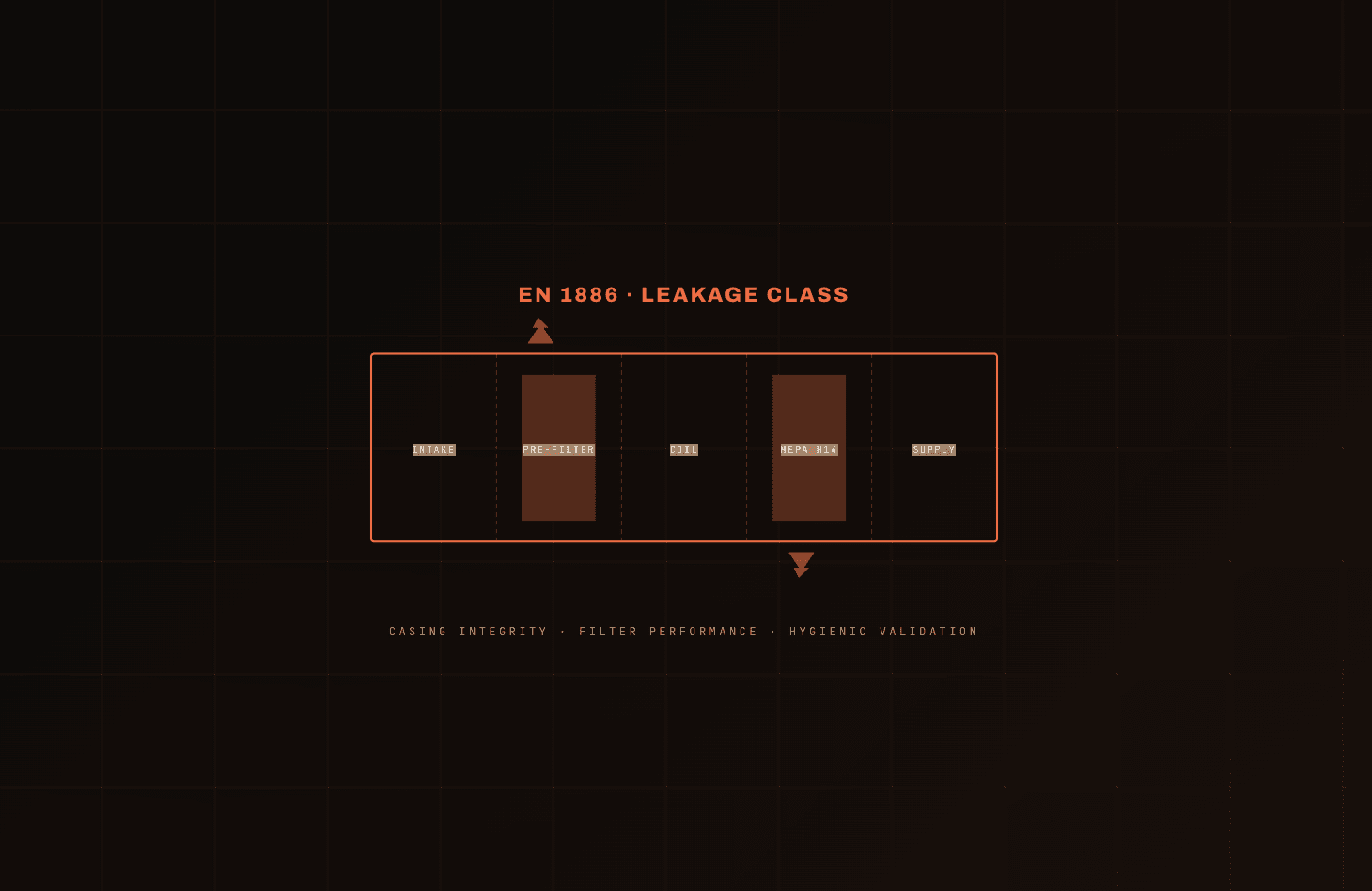
Adding a HEPA H14 filter to your operating room project is not enough for excellent indoor air quality. If the AHU casing leaks, dirty air will mix into the sterile zone before reaching the filter. The EN 1886 leakage class is the engineering requirement that comes before the filter in critical environment HVAC.
During the commissioning phase of a new hospital project, the initial leak test of the operating room air handling unit is performed. The specification includes a HEPA H14 filter, conventional laminar flow system, advanced BMS controls — they are all written down. The test result comes back: the particle counter is above the threshold. Filters are checked; they are secure in their place. No cause can be found.
The technical supervisor finally identifies the source: unfiltered air is leaking from the ambient space into the unit through the panel joints of the unit casing under -400 Pa negative pressure. This air mixes with the main flow and passes directly to the supply duct without passing through the HEPA filter. In other words, the system is technically bypassing the HEPA filter.
This situation is a result of a parameter that is overlooked in hygienic air handling unit design but actually comes before filter selection: the EN 1886 casing leakage class.
1. What Does the EN 1886 Standard Measure?
EN 1886 is the European standard that classifies the mechanical and aerolic performance of the air handling unit casing. It focuses on five main performance criteria:
Casing Leakage: L1, L2, L3 classes
Filter Bypass Leakage: F5 to F9
Mechanical Strength: D1, D2, D3
Thermal Transmittance: T1 to T5
Thermal Bridging Factor: TB1 to TB5
Among these criteria, the casing leakage class is the most critical in hygienic applications. Because if an air handling unit cannot maintain its casing integrity under operational pressure difference, it renders the indoor air quality unvalidated, regardless of which filter is installed.
2. L1, L2, L3 Casing Leakage Classes
Three classes limit the amount of air leaking into the casing volume from the outside under -400 Pa static pressure in liters/second/m² (l/s·m²). As the casing surface area increases, the tolerable leakage amount increases proportionally, but the ratio remains constant.
L3 — Standard Comfort Applications
It is sufficient for office buildings, shopping malls, general commercial and residential applications. The leakage rate is at an acceptable level because millimeter-micron level particle control is not required for indoor air quality.
L2 — Medium Level Hygiene
Suitable for laboratories, food production facilities, pharmaceutical packaging areas, and cosmetics production. While casing leakage is restricted, the cost-performance balance is maintained.
L1 — Critical Environment Applications
It is mandatory, not optional, for operating rooms, intensive care units, delivery rooms, isolation rooms, sterile production (pharma GMP class A/B), microbiology, and BSL-3 laboratories.
Engineering distinction: Installing an H14 filter in an L3 class casing is like putting sterile food in a refrigerator whose door does not close properly. The system does not work alone — the filter and the casing work together.
3. How is Casing Leakage Verification Performed?
The leakage test is performed at the manufacturer during the factory-out stage, but project-specific validation must be repeated in the field. The standard procedure is as follows:
All inlets and outlets of the unit are sealed airtight
The internal volume is reduced to -400 Pa static pressure using a test fan
The air flow required to keep the pressure constant is measured
This flow rate is divided by the casing surface area to calculate the leakage rate (l/s·m²)
The result must remain below the class limit
In an L1 class unit, the typical value is in the range of 0.08-0.12 l/s·m². Units that are very close to the limit cannot maintain their class during their operational life due to gasket and panel deterioration. Therefore, brands that leave a safety margin should be preferred in manufacturer selection.
4. Structural Features of an L1 Class Unit
A real L1 unit is fundamentally different from L3 in terms of production technology. Simply using better gaskets is not enough. The following features are mandatory:
Double Skin Casing
Double skin panel structure with mineral wool filling between the inner and outer surfaces. Usually 50-60 mm thick. Single skin casing cannot achieve L1 class.
Thermal Bridge-Free Profile (TB1)
Frame profiles are designed in such a way that they do not create thermal bridges in the casing. Otherwise, condensation, gasket deterioration, and increased leakage occur in humid environments.
Professional Joint Sealing
Special EPDM or silicone-based profile gaskets are used in panel joints. A bolt pattern is designed to apply strategic clamping force at the corner joints.
Inner Surface Hygiene
Smooth, rounded-corner inner surface compliant with VDI 6022 and DIN 1946-4 standards. Drainage slopes that prevent water accumulation. Coil pans are made of stainless steel.
5. How to Specify It in Specifications?
In projects requiring hygienic air handling units, leaving the specification sentence only as "hygienic air handling unit with HEPA filter" opens the door to all the validation problems mentioned above. The correct specification statement should specify the following five parameters together:
Casing leakage class: EN 1886 · L1
Filter bypass leakage: F9
Mechanical stability: D1
Thermal transmittance: T2 or better
Thermal bridging: TB1 or TB2
Also: compliance with VDI 6022 for inner surface hygiene and DIN 1946-4 for hospital environments must be specified.
Axvorn note: When preparing a hygienic unit proposal, the first thing we always ask is the casing leakage class in the project specification. If it is not specified in the specification, we determine the mandatory class based on the application type (operating room, laboratory, pharma) and present its justification in the proposal annex. A unit in the wrong class will fail during the validation phase of the project — putting the entire investment at risk.
Conclusion: Casing is as Important as the Filter
In a hygienic air handling unit, "installing a filter" is not a solution on its own. Casing leakage class is an engineering parameter you must decide on before the filter. The combination of an L1 class casing and H14 filter creates a system that passes validation.
L1 is mandatory in critical environments such as operating rooms, pharmaceutical production, isolation rooms, and BSL-3 laboratories. This is not a choice, it is a requirement of the standard.
As Axvorn Engineering, we offer L1 casing leakage, F9 filter bypass, D1 mechanical stability, and TB1 thermal bridge-free profile parameters as default in our hygienic air handling unit projects. Hygiene is not optional.
Get a Free Technical Evaluation for Your Project in 48 Hours